
Private tour guide in Rio de Janeiro
21 96496-9381
21 96496-9381
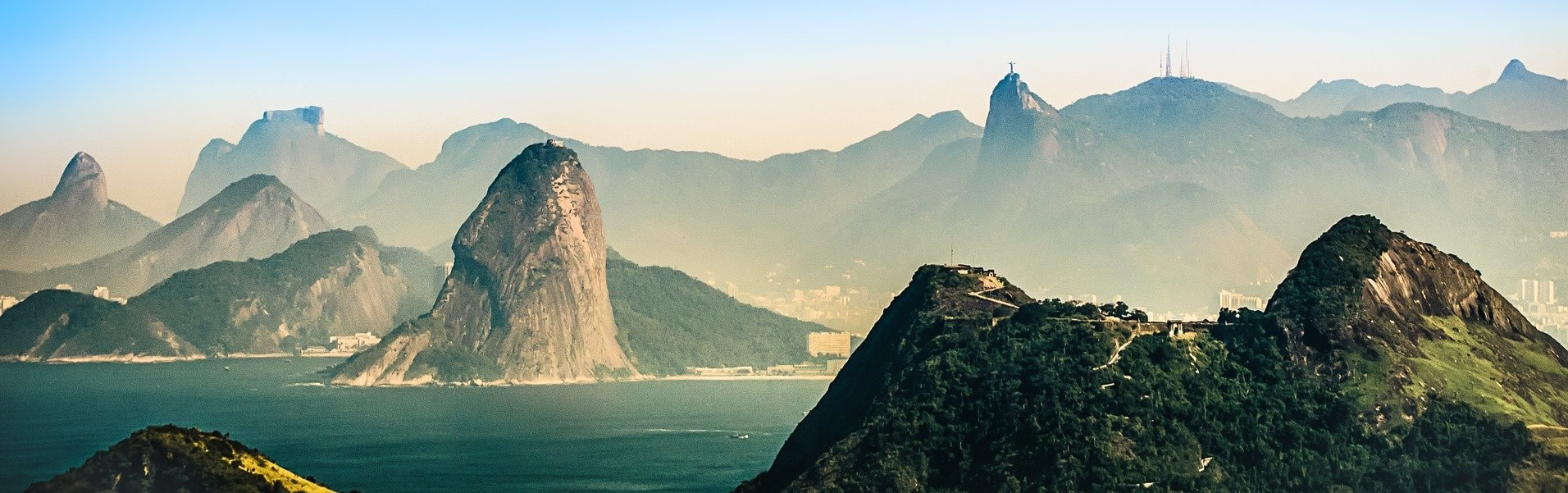
Before 1565, when Estácio de Sá founded the city, Guanabara Bay was Tupinambá territory. Dozens of villages lined the shore, belonging to an organised society with its own politics, warfare and ritual. Almost everything a visitor sees in Rio today carries an Indigenous name, runs over an Indigenous river or stands on the ground of a former village. The city did not begin in 1565: it was built on top of another one.
Guanabara Bay seen from Niterói. The same landscape the Tupinambá villages occupied until the sixteenth century.
Carioca is the most used and least understood word in Rio.
The explanation found in tourist leaflets says it comes from house of the Carijó. It does not hold up: the Carijó lived much further south, on the coast of Santa Catarina.
In the reading argued by Rafael Freitas da Silva in O Rio antes do Rio, the term comes from the Tupi kari'oka, formed by kara'iwa, the white man, the foreigner, and oka, house. House of the white man. The name did not describe a people: it described a building. A stone house raised by Europeans beside a river running down from Corcovado.
The river inherited the name of the house. The people inherited the name of the river. And Rio de Janeiro spent four centuries calling itself by a nickname the Tupinambá gave to the invader.
The Carioca river still exists. It rises in the Tijuca Forest, crosses Cosme Velho and Laranjeiras and reaches the sea at Flamengo, almost entirely channelled. You drive over it several times without knowing.
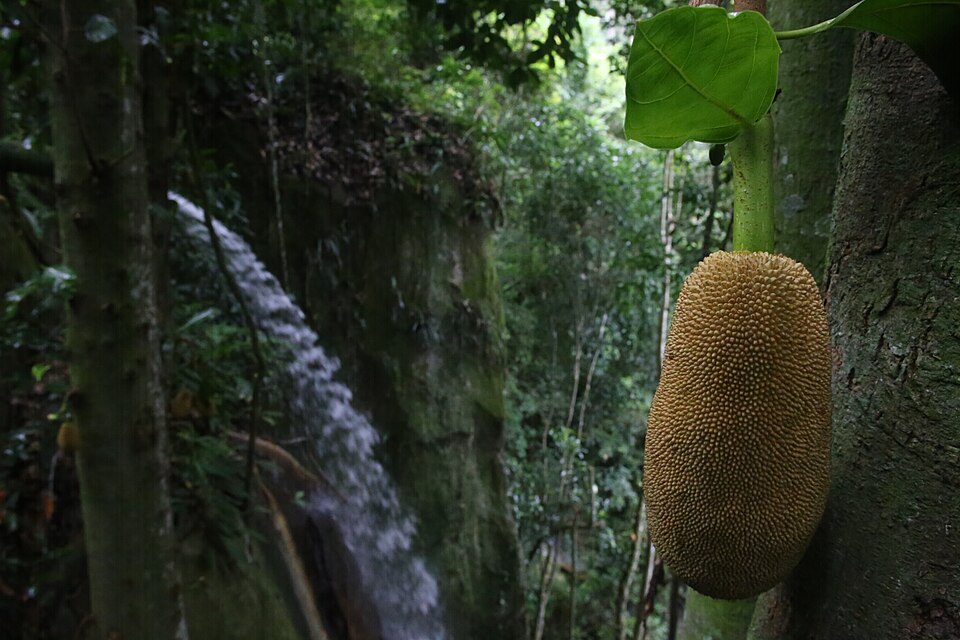
Headwaters of the Carioca river, in the Tijuca Forest.
The word Indian flattens hundreds of different peoples into one. The Tupinambá of Guanabara had a social organisation that sixteenth-century European chroniclers described in detail, and that rarely appears on a tourist itinerary.
The village. It was called taba. It gathered four to eight communal houses, the ocas, arranged around a central yard, the terreiro. Each oca could shelter more than a hundred people, families linked by kinship, with hammocks slung in rows and fires kept burning at all times. Nobody lived alone. The idea of an individual house was, to them, incomprehensible.
Power. The morubixaba led but did not command. His authority came from prestige in war and the ability to persuade, not from an office. Important decisions went through the council of the older men, in meetings that could last for nights. A chief who lost the confidence of the village lost the leadership, with no formal removal and no violence: people simply stopped following him. It was a society that distrusted concentrated power.
The pajé. He handled what we would now separate into medicine, religion and politics. He interpreted dreams, treated illness, led rituals and gave his view on war. Some pajés, the caraíbas, travelled between villages and held influence no chief could reach.
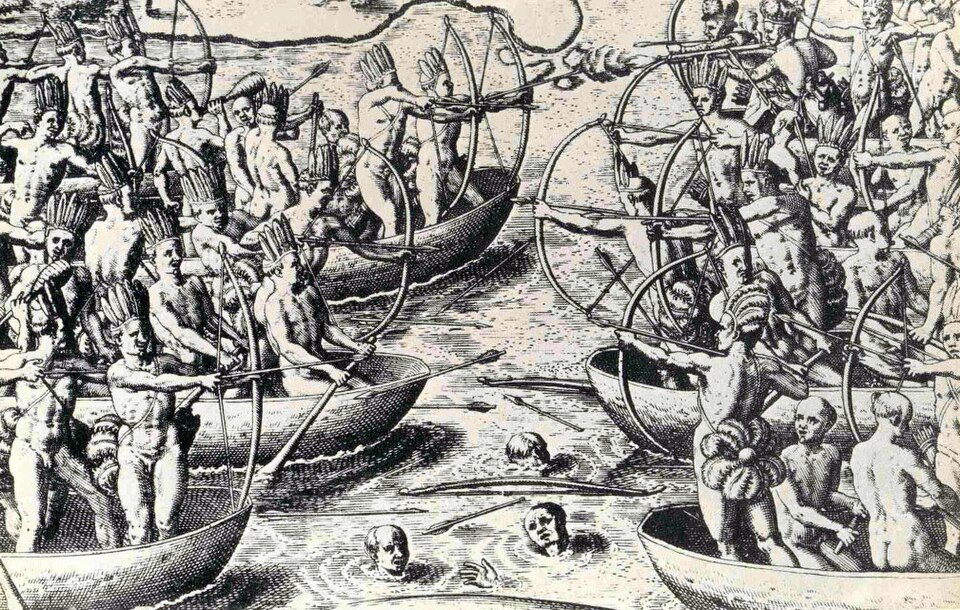
Combat between Tupi groups in canoes. Engraving by Theodor de Bry for Hans Staden's Two Voyages to Brazil, 1557.
The anthropophagic ritual. This is the part Europeans described most and understood least. A prisoner taken in war was not killed the next day. He lived in the village, sometimes for years. He was given food, a house and often a wife. He moved about freely. He could even have children. And he knew all along how it would end. Escape was dishonour, and there are accounts of prisoners who had the chance to flee and did not.
On the day of the execution, in the terreiro, before the whole village, the prisoner traded ritual insults with the executioner. He was expected to die with courage and defiance. After the blow with the ibirapema, the executioner received a new name and marks on his body that he would carry for life.
It was not hunger, nor gratuitous cruelty. It was a system of revenge and honour that structured relations between villages, and which Europeans, who at the same time burned people alive in their own public squares, described as savagery.
The closest records came from Hans Staden, a German who spent months as a prisoner of the Tupinambá and published his account in 1557, and Jean de Léry, a French Calvinist who lived in Guanabara and wrote one of the most remarkable sixteenth-century books about Brazil.
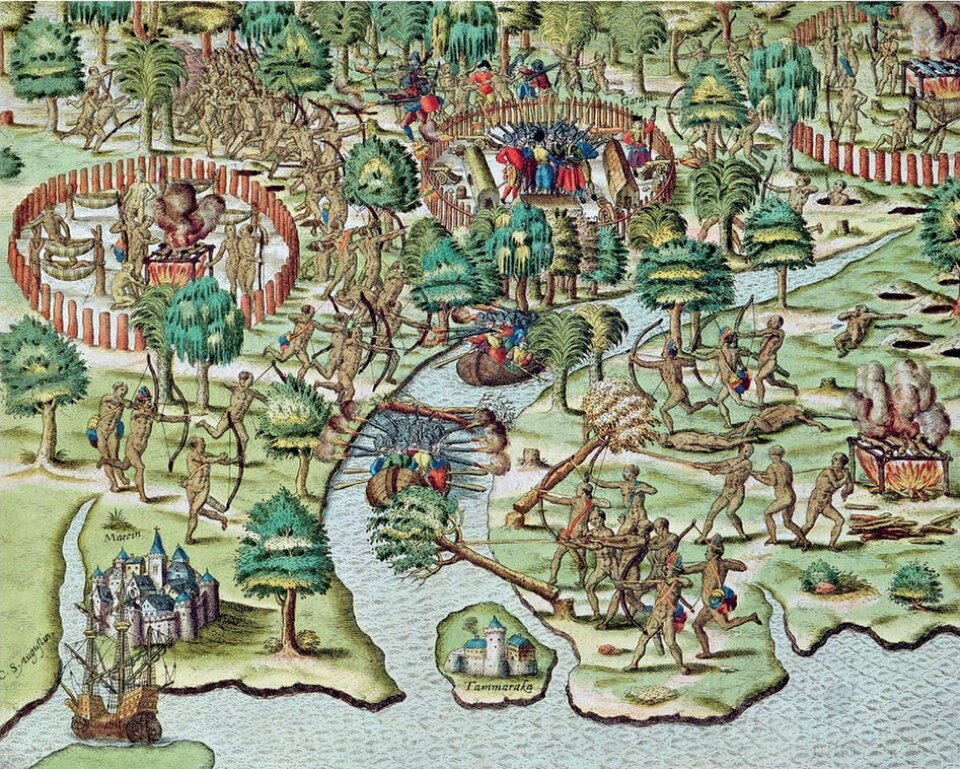
The siege of Igarassu, in Pernambuco. Engraving by Theodor de Bry for Hans Staden's work, 1557. The scene is not from Guanabara, but it shows Tupi warfare as Europeans recorded it.
The founding of Rio is usually told as Portugal against France. That is half the story.
The Tupinambá were allies of the French of France Antarctique, established in Guanabara since 1555. The Portuguese had on their side the Temiminó, led by Araribóia, another Tupi people and a historical enemy of the Tupinambá.
The Portuguese conquest of Rio was decided by an Indigenous alliance. Without the Temiminó, history would have ended differently. Araribóia received for this land on the other side of the bay, where Niterói stands today, a city whose name, nhiteroî, is usually translated as hidden water.
The defeated Tupinambá were dispersed, enslaved or pushed inland. Within a few decades, the people who occupied the whole shore of Guanabara had all but vanished from it.
Guanabara, in the most accepted reading: inlet, bosom of the sea. Tijuca: marsh, mud. Maracanã: a bird. Ipanema: bad water, water unfit for fishing. Jacarepaguá: shallow lagoon of the caimans. Irajá, Inhaúma, Guaratiba, Sepetiba, Paquetá, Niterói. The map of Rio is a Tupi dictionary the city reads aloud every day without understanding it.
One detail that corrects a common mistake: Copacabana is not Tupi. It comes from Aymara, from the Lake Titicaca region, and reached Rio through the devotion to Our Lady of Copacabana. It is the foreign name in the middle of an Indigenous map.
Three centuries later, the city above the city gained chroniclers of its own.
Machado de Assis was born on Morro do Livramento in 1839, in the port district where enslaved Africans were landed. He knew the old centre street by street, and his novels pass along Rua do Ouvidor, Largo de São Francisco, the corners that are still there.
João do Rio, at the start of the twentieth century, did the opposite of what was expected of an elegant chronicler: he walked. A alma encantadora das ruas, from 1908, records a Rio that the Pereira Passos reform was demolishing. The street vendors, the tenements, the terreiros, the people the new city wanted to hide.
Reading both before walking through the old centre changes the walk. You stop seeing façades and start seeing layers.
Tupinambá Rio has no monument and no plaque. But it is in specific places.
The Carioca river, visible in stretches of Cosme Velho and Laranjeiras, the river that gave all of us our name.
Pedra do Sal, in Saúde, a granite outcrop used long before the Portuguese arrived and later central to the formation of samba.
The port district, where the archaeology of Cais do Valongo revealed overlapping layers of occupation.
The National Museum, at Quinta da Boa Vista, which held the country's largest Indigenous collection until the 2018 fire and remains under reconstruction.
Guanabara Bay itself, seen from any high viewpoint. The landscape the Tupinambá occupied is the same one that is there. Only the buildings changed.
O Rio antes do Rio, by Rafael Freitas da Silva, the main reference for this text.
Two Voyages to Brazil, by Hans Staden, 1557, the account of a prisoner of the Tupinambá.
History of a Voyage to the Land of Brazil, by Jean de Léry, 1578, the fullest description of Tupinambá life in Guanabara.
A alma encantadora das ruas, by João do Rio, 1908, the Rio of the streets before the demolitions.
Written by Marco Viggiani, licensed tour guide in Rio de Janeiro, CADASTUR 19.026072.96-0, with 15 years of experience in historical and cultural itineraries. Historical walking itineraries in Rio on request.
Tell us what you would like to see and we will build the itinerary with you.
See all Back to the blogThe city is wonderful. The experience can be even better.
Tell us what you would like to see and we will build the itinerary with you.
Talk to Marcao